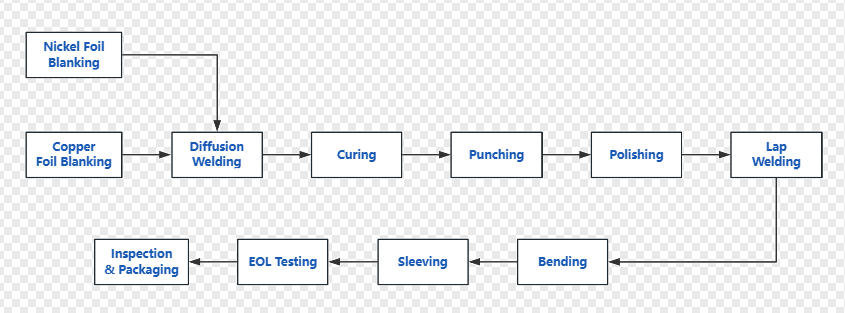
The process sequence used in high-volume EV and power electronics manufacturing is:
Copper busbars are essential components in electrical systems, used for distributing high currents in applications such as electric vehicles, battery packs, switchgear, and power distribution networks. Efficient and precise bending of copper busbars is critical to ensure electrical performance, mechanical integrity, and assembly fit. This guide explores cost-effective methods for bending both flexible and hard copper busbars using miniature press brakes.
Types of Copper Busbars and Their Applications
Copper busbars are broadly classified into two categories:
Flexible (Laminated) Copper Busbars: Made from stacked thin copper foils, often reinforced with nickel at connection points. They offer high conductivity, flexibility, and vibration resistance, making them ideal for battery interconnects, inverter busbars, and dynamic environments.
Hard (Solid) Copper Busbars: Manufactured from solid copper plates or sections. They provide mechanical strength and thermal mass, commonly used in main power distribution paths, switchgear, and high-current systems.
Key Challenges in Copper Busbar Fabrication
Fabricating copper busbars presents several challenges:
High mix, low volume production: Frequent design changes and small batch sizes demand flexible manufacturing setups.
Insulation protection: Delicate insulating films (e.g., polyimide) can be damaged during bending, leading to electrical risks.
Tight tolerances: Bend angles, hole positions, and flatness must be tightly controlled (±0.5° angle, ±0.1 mm hole position) to avoid assembly issues and thermal hotspots.
Why Miniature Press Brakes Are Ideal for Copper Busbar Bending
Miniature press bridges offer a practical and economical solution between manual bending and large automated systems. Key advantages include:
Compact size and quick tooling change: Enables fast setup changes for different busbar geometries.
Specialized tooling and soft clamping: Protects insulation and prevents surface damage.
High-precision servo/stepper control: Ensures repeatable bends and compensates for springback.
Adaptive bending strategies: Multi-step bending reduces stress on laminated busbars and prevents delamination.
Typical Workflow for Bending Copper Busbars on a Miniature Press Brake
Programming: Import DXF files or enter bend parameters into the CNC controller.
Loading: Secure pre-cut blanks using vacuum or soft-clamp fixturing.
Bending: Execute programmed bends, using multi-step routines for sensitive materials.
Inspection: Verify dimensions with calipers, angle gauges, or CMM.
Batch production: Run approved jobs with high repeatability.
Post-processing: Apply plating, insulation, or coatings as required.
How to Select the Right Miniature Press Brake
Consider the following when choosing a press brake for busbar production:
Tonnage: 6–12 tons is typically sufficient for most copper busbars.
CNC control: Look for user-friendly controllers with recipe storage and CAD import.
Tooling availability: Use purpose-made dies for busbars, including rounded punches and soft lower dies.
Fixturing: Opt for vacuum or low-force clamps to protect insulation.
Precision: Ensure servo-driven axes and high-resolution encoders for accurate bending.
Conclusion: Empowering New-Energy Manufacturing with the Right Tooling
Copper busbar bending requires a balance of electrical performance and mechanical accuracy. By adopting miniature press brakes with tailored tooling, manufacturers can achieve repeatable, cost-effective, and high-quality bends for both flexible and hard busbars. This approach supports the fast-evolving demands of electric vehicle and renewable energy industries.
For assistance in selecting the right press brake for your copper busbar application, consult with equipment specialists who can provide process trials and sample bending tests based on your specific requirements.